
HOME / ENGINEERING/ POLYURETHANE WHEELS AND ROLLERS

What Are Our Polyurethane Production Processes?

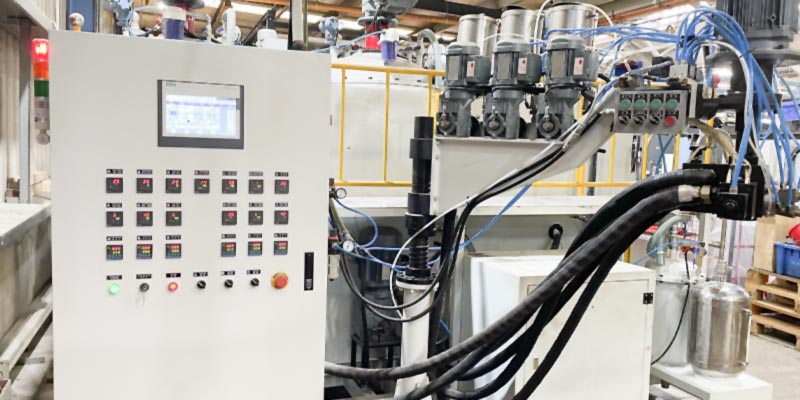
Unlike many of our competitors who mix prepolymers and catalysts by hand in plastic buckets – an imprecise process that can be prone to defects that may not become apparent until a component fails in service – Richmond Rolling Solutions exclusively casts and processes polyurethane using our custom-built precision polyurethane casting machines.

Polyurethane production is a carefully controlled process that prepares, mixes, casts and cures liquid polyurethane materials into finished components. Every stage, from preparing the raw materials through to post-curing and final machining, is completed under controlled conditions to ensure the process is repeatable and consistent.

Polyurethane production is a carefully controlled process that prepares, mixes, casts and cures liquid polyurethane materials into finished components. Every stage, from preparing the raw materials through to post-curing and final machining, is completed under controlled conditions to ensure the process is repeatable and consistent.

Polyurethane begins as prepolymers, which are high-viscosity liquids. Different prepolymers are used to produce specific grades and hardnesses of polyurethane depending on the requirements of the finished component. Most of the polyurethane materials we process are two-part systems consisting of a prepolymer and a catalyst, with each component kept separate until the casting process begins.

Before casting can take place, the raw materials are carefully prepared inside the casting machine. The prepolymer and catalyst are stored in separate heated vessels where they remain isolated until they are required for mixing.

The raw materials are kept under high vacuum to extract any gases from the polymer before casting. During this preparation stage, the materials are also gently stirred within the vessels to maintain an even heat distribution. Once the materials have been degassed and heated to the required casting temperature, they are ready for casting.

Our 10-Step Casting Process

Polyurethane production is a carefully controlled process that prepares, mixes, casts and cures liquid polyurethane materials into finished components. Every stage, from preparing the raw materials through to post-curing and final machining, is completed under controlled conditions to ensure the process is repeatable and consistent.

1. Precision Material Metering

The casting process begins by programming the required material volume into the casting machine. The machine then pumps the specified volume and ratio of prepolymer and catalyst through heated pumps and hoses to the mixing head, where the two materials are combined immediately before casting.

2. Mixing and Casting

Depending on the component being manufactured, the mixed polyurethane is either used to fill open cast moulds or, for more complex parts, delivered via a hose for low-pressure injection into the mould.

3. Mould Temperature Control

Before any polyurethane is poured, all moulds are preheated to the same temperature as the liquid polyurethane. By controlling the temperature of both the moulds and the material throughout the process, we ensure that even polymerisation can occur once casting begins.

4. Polymerisation Begins

After each batch of moulds has been filled, the catalyst begins reacting with the prepolymer and the polymerisation process starts. This chemical reaction gradually transforms the liquid polyurethane into a solid material.

5. Green Casting Formation

After approximately three to ten minutes, the polyurethane has solidified into a semi-cured stage known as a green casting. At this point, the component has formed its shape and is no longer a liquid, but it has not yet reached its final strength.

6. Initial Tempering

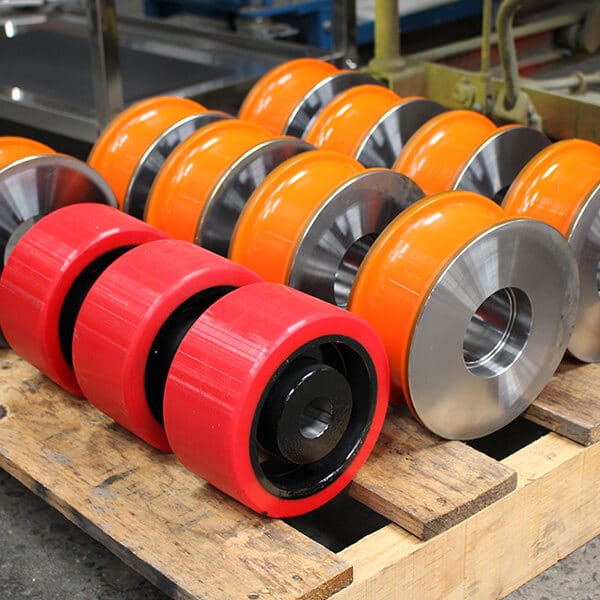
In Australia and New Zealand, we stock a huge range of standard off the shelf polyurethane tyred wheels and rollers, as well as an even bigger selection of standard made-to-order options.

If you’re seeking a wheel or roller for a common application, then chances are we have a suitable option for you in stock in your state, or at our Victorian warehouse.

7. Oven Curing

Depending on the polyurethane grade and the size of the component, heat is used to accelerate the cross-linking of the polymer chains and complete the polymerisation process.

8. Full Cure

Typical curing times range from 9 to 16 hours, allowing the polyurethane to achieve its full strength.

9. Controlled Cooling

Once the required curing time has been completed, the industrial oven is turned off and the polyurethane castings are allowed to slowly temper back to room temperature before any finishing operations begin.

10. Finishing and Machining

Finished polyurethane components generally require cleaning before being packaged for shipment. Where the finished product is a polyurethane wheel or roller, the polyurethane tyre is typically machined on a precision lathe to achieve the specified final diameter and concentric alignment with the wheel centre before the component is prepared for delivery.

How does polyurethane compare to other materials?

Compared To Rubber Compared to Metal Compared To Injection Moulded Plastics
Superior abrasion resistance
Abrasian resistance
High impact resistance
Wide range or hardness for more application flexibility
Non-corrosive
Much lower tooling cost
Lighter load bearing
Light weight
Elastic memory
Cut and tear resistant
Flexible
Thick and thin section mouldings
UV and ozone resistance
Impact resistant
Noise reduction
Lower cost tooling
Nonconductive
Lower and higher temperature range capable
Thicker sections possible
Non-sparking
Resilience
Parts with very thick and thin sections possible
Lower cost fabrication
Elastic memory
Colourability
Lower cost tooling compared to cast steel/iron parts
Wide range or hardness for more application flexibility
Can be manufactured with a FRAS Rating (fire resistance & antistatic)
Noise reduction in impact applications
Abrasion resistance
Won’t damage other steel or concrete surfaces like steel components

Standard Polyurethane Material Properties

Hardness 50A (+/-3) 60A (+/-3) 77A (+/-3) 85A (+/-3) 90A (+/-3) 95A (+/-3) 57D (+/-3) 65D (+/-3) 75D (+/-3) Test Method
Tensile Strength MPA (psi) 15 (2175) 16 (2321) 27.0 (3916) 38 (5500) 34.0 (4931) 41.0 (5947) 38.8 (5627) 48.0 (6926) 51.6 (7484) AS1683.15
100% Modulus MPA (psi) - - 4.6 (667) 6.7 (972) 9.0 (1305) 12.4 (1789) 7.9 (1146) 29.0 (4206) 46.9 (6802) AS1683.11
200% Modulus MPA (psi) - - - - 13.4 (1944) 17.3 (2509) - - 39.3 (5700) AS1683.11
300% Modulus MPA (psi) - - 9.0 (1305) 11.0 (1595) 18.6 (2698) 17.9 (2596) 11.9 (1726) 38.0 (5511) - AS1683.11
Angle Tear Strength, Die C (KN/m) - - 72 83 98 120 155 115 143 AS1683.12
Trouser Tear Strength (KN/m) - - 25 35 30 41 52.7 - - AS1683.12
Elongation % 650 600 615 650 580 400 335 280 200 AS1683.11
Din Resilience (%) - 55 65 61 50 41 45 - 45 DIN 53512
Din Abrasion Resistance 10N (mm3) - 135 43 25 27 55 76 110 109 AS1683.21
Din Abrasion Resistance 5N (mm3) - - - - 10 18 35 35 - AS1683.21
Cured Specific Gravity (g/cm3) 1.1 1.1 1.05 1.07 1.1 1.13 1.14 1.13 1.17 AS1683.40

The perfect partner for custom polyurethane products

For specific applications Richmond Rolling Solutions can expertly manufacture polyurethane products in any hardness from 25A to 85D.

Using precision engineering techniques and the latest equipment, Richmond Rolling Solutions can design and deliver any type of polyurethane product for your business needs! 

By utilising Richmond’s in-house moulding processes we can manufacture custom shapes, hardness variability and load bearing solutions, giving us a distinct advantage over traditional suppliers across Australia.


What makes us different?

  • In-House Manufacturing Capabilities

    Our skilled operations team have expertise in the use of manufacturing machinery that enables both a fast turnaround and a high level of quality control. Our engineers work side by side with the machine operators.

  • Tailored and Engineered Solutions

    We have over 6 decades of experience as a big project, critical component partner for moving bulky items. We design and manufacture practical and uncomplicated solutions that align with the project requirements.

  • F.R.A.S Polyurethane Solutions

    A polymer additive used in the manufacture of polyurethane products makes the solution fire resistant and anti-static. It is ideal for use in mining, pipeline and fluid transport systems.

  • Design in SolidWorks

    A commonly used engineering design software that enables the convenience of file sharing.

  • ISO9001 Accredited

    Our processes are internationally accredited, ensuring a high-quality fit for purpose solution that is rigorously tested and reviewed before delivery to market.

  • Fast Turnaround

    From concept to solution, our design, sourcing and manufacturing infrastructure enables us to meet the tightest of deadlines.

FAQ

Yes. Our in-house engineering team can assist with product design, mould tooling, material selection, and performance requirements for any industrial application.

Our polyurethane solutions are used in manufacturing, mining, transport, food processing, agriculture, and OEM equipment – anywhere parts need to handle wear, load, impact, or movement.

Yes. We offer both low and high-volume production and can create short-run castings with custom tooling if needed.

We offer both. Alongside custom polyurethane solutions, we stock a wide range of  polyurethane wheels, rollers, and standard shaps to suit common industrial and OEM applications. Meaning we’ve got you covered whether you need a standard wheel or a more complex problem solved.

Yes. We can supply polyurethane in a range of standard sheet and rod formats, ready for your own fabrication or CNC processes.

We do. We can finish moulded parts to spec using our in-house CNC lathes and machining centres – particularly useful for tight tolerances or complex profiles.

Yes. You can send technical drawings, CAD files, photos or dimensions via email or contact form to our team. We will review your requirements, provide a quote, and can supply drawings for approval before we begin production.

Ready to Get Started?

With nearly 10,000 products in our growing range, why not talk with our design and engineering team about our custom polyurethane product solutions?

Give us a call on 1300 474 246 or submit an enquiry using the below form. Our team is here to help you find the right solution!

  • Accepted file types: jpg, png, pdf, cad, Max. file size: 5 MB.

Get our latest news and offers straight to your inbox

Your Cart

×

No products in the cart.

We use cookies to optimise your experience of our website. Please read our Privacy Policy for more information.

OK