



Frequently Asked Questions
What’s the difference between a manual and electric fork stacker?
Manual stackers use foot or hand pumps to raise the forks hydraulically. Electric models feature battery-powered lift mechanisms for easier operation and are better suited to frequent or heavier loads.
Do I need a forklift licence to operate a fork stacker?
In most cases, no. Fork stackers are pedestrian-operated and generally don’t require an LF-class licence. However, training is still essential and local regulations should always be checked.
Can I use a fork stacker on sloped or uneven surfaces?
Fork stackers should only be used on level, hard surfaces. Slopes or uneven flooring can affect stability and pose a tipping hazard.
How do I choose the right stacker for my application?
Consider the load weight, lift height, and usage frequency. Manual stackers are ideal for lighter, occasional use. Electric models are better for heavier loads or regular use. Also factor in aisle width and available floor space.
What is the maximum weight a fork stacker can lift?
Richmond’s stackers typically range from 400kg to 1500kg capacity depending on model. Always check the rating of the specific unit and stay within its limits.
Does lift height impact how much I can lift?
Yes. As the lift height increases, the maximum load rating decreases. Always refer to the load chart supplied with the unit.
Can fork stackers lift non-palletised loads?
Yes, if the load is stable and secure on the forks. Some stackers support attachments like platforms or drum lifters for handling irregular items.
Fork Stackers & Walkie Stackers
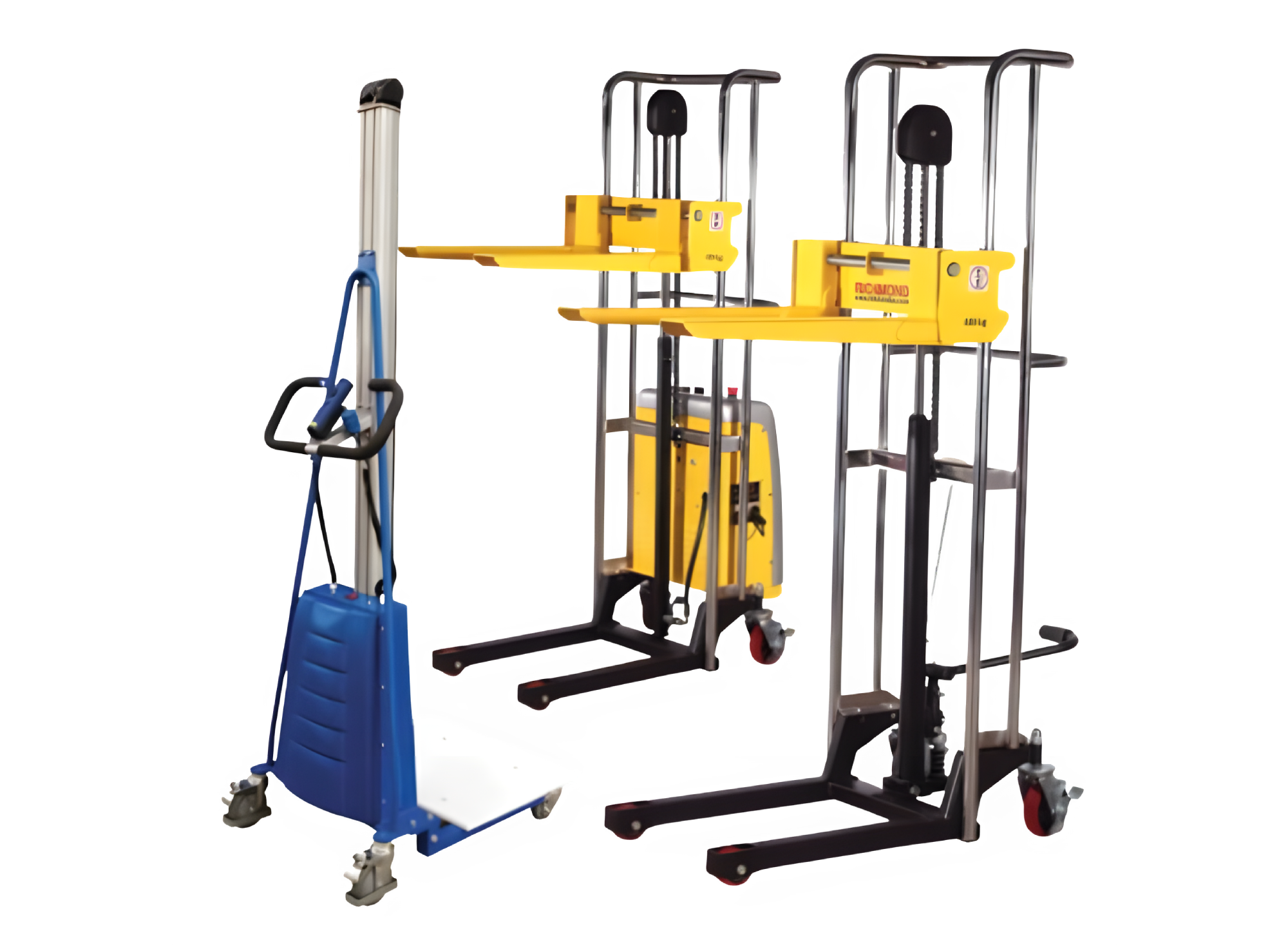
Richmond’s range of fork stackers provides a reliable solution for lifting and stacking goods in compact spaces across warehouses, workshops, logistics operations and manufacturing plants. Also known as walkie stackers or pedestrian forklifts, these units are designed for controlled vertical lifting where full-sized forklifts are not practical.
Available in both manual fork stackers and electric stackers, these machines support safe and efficient pallet handling while reducing manual lifting. Their compact, walk-behind design allows operation in confined areas, making them suitable for stockrooms, narrow aisles and back-of-house environments.
Built from durable steel and designed for industrial use, fork stackers offer dependable performance for Australian industrial and commercial applications.
View Material Handling Equipment Range
Material Handling & Pallet Stacking Equipment
Fork stackers are widely used for material handling, pallet stacking and equipment positioning in workplaces where space is limited. Their pedestrian-operated design allows operators to manoeuvre loads with precision while maintaining clear visibility and control.
In warehouses, workshops and logistics centres, stackers support efficient stock handling, including lifting pallets onto racking, transferring goods between work areas and assisting with loading tasks. Electric models are suited to indoor use where low noise and no exhaust fumes are required.
These machines improve workplace efficiency by reducing manual handling effort and supporting safer load movement in day-to-day operations.
Product Types by Application
Manual Fork Stackers
Manual fork stackers use hydraulic systems to lift loads, providing a simple and cost-effective solution for low to medium frequency lifting tasks.
These units are commonly used in workshops, small warehouses and maintenance areas where occasional pallet lifting is required without the need for powered equipment.
Electric Fork Stackers
Electric fork stackers use battery-powered lift and drive systems to handle higher frequency operations with reduced operator effort.
They are suited to warehouses, logistics operations and manufacturing plants where regular pallet stacking, transport and positioning are required.
Walkie Stackers (Pedestrian Operated)
Walkie stackers are designed for walk-behind operation, allowing precise control in tight spaces and narrow aisles.
These units are commonly used in stockrooms, retail distribution areas and confined workspaces where larger forklifts cannot operate efficiently.
Specialty Product Options
High Lift Mast Configurations
High lift mast designs allow fork stackers to raise pallets to elevated racking or shelving systems.
These configurations are suited to warehouses and storage facilities where vertical space utilisation is required.
Adjustable Fork Widths
Adjustable fork widths enable handling of different pallet sizes and load types.
This flexibility supports varied applications across logistics, manufacturing and commercial workplaces.
Built-In Safety Features
Fork stackers are equipped with safety features such as wheel brakes, load backrests and stable base designs.
These features improve operator control and reduce risk when lifting and transporting loads in busy environments.
Compact Footprint Design
Compact designs allow stackers to operate in confined areas with limited turning space.
This makes them suitable for narrow aisles, stockrooms and smaller warehouse facilities.
Applications by Industry
- Warehousing & Logistics: Fork stackers and pallet handling equipment for pallet stacking, inventory movement and narrow aisle operation.
- Manufacturing & Workshops: Walkie stackers for moving materials between production areas and workstations.
- Retail Distribution: Pedestrian stackers for stock handling in back-of-house and compact storage areas.
- Loading Docks: Fork stackers for transferring pallets to and from trucks in controlled spaces.
- Maintenance & Service Areas: Stackers for lifting equipment and tools in confined workshop environments.
Industrial Equipment Solutions Across Australia
Richmond supplies a wide range of fork stackers and material handling equipment across Australia, supporting industrial, warehouse and commercial operations. With a focus on durability and performance, our products are backed by local expertise and a nationwide support network.
Contact your local Richmond team for advice on the right stacker for your application.